Meat alternatives start with particle precision
The texture of plant-based meat is largely determined before the extruder is even switched on.
For Swiss milling group Groupe Minoteries, entering the textured vegetable protein market meant moving beyond conventional flour processing into a far more demanding area of powder engineering. Producing plant-based meat alternatives requires protein particles with tightly controlled size distribution, because even small variations directly affect hydration, extrusion behavior, and final product texture.

From flour milling to functional protein engineering
Groupe Minoteries has decades of experience in grain processing, but textured vegetable protein places very different demands on production. Unlike flour, plant proteins must be prepared as highly consistent functional powders before they can be transformed into meat analogues.
In this case, the process challenge was not simply grinding protein ingredients—it was creating a precisely defined particle profile that behaves predictably during extrusion. If particle size varies too widely, water absorption becomes uneven, extrusion pressure fluctuates, and the final product loses structural consistency.
Hosokawa Alpine’s milling and classification technology enabled Groupe Minoteries to create exactly that controlled protein feedstock: a powder engineered not just for size reduction, but for stable downstream functionality in plant-based mince applications.
Why particle size defines texture
In plant-based meat production, extrusion often receives most of the attention, yet extrusion can only perform as well as the powder entering it.
Particles that are too coarse hydrate unevenly and weaken texture formation. Particles that are too fine may compact excessively and compromise fibrous structure. Consistent classification is therefore what allows protein powders to form repeatable meat-like textures with the right bite and cooking behavior.
That is where powder process engineering becomes commercially decisive. The ability to control particle size precisely gives manufacturers tighter process stability, less batch variation, and a more reliable final product.
A wider shift in food manufacturing
What makes the Groupe Minoteries case especially relevant is what it represents beyond one installation.
Traditional milling companies are increasingly evolving into advanced ingredient producers, using their raw material expertise to move into higher-value protein applications. Plant-based meat is accelerating that transition—but success depends on mastering processes that go far beyond conventional flour technology.
For manufacturers entering this category, the lesson is clear:
In plant-based meat, texture does not begin in the extruder.
It begins in the particle design of the powder itself.
Related equipment
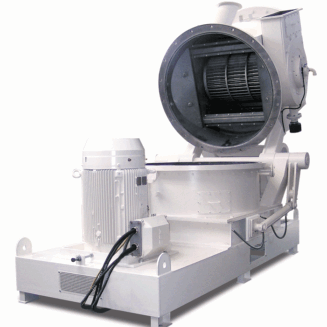
Classifier mill for soft products
For grinding soft products up to a Moh´s hardness of 3.5. The end products are free from ...
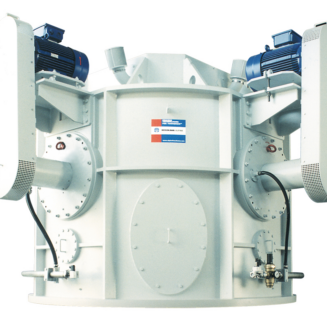
Ultrafine air classifier
For ultrafine classifying operations of mineral fillers such as limestone or calcite, dolomite, talc...