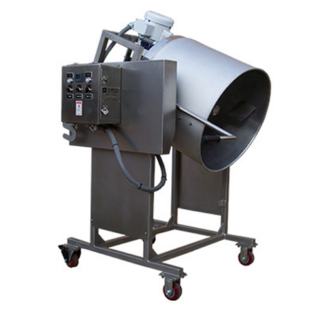
Caramel coating in industrial popcorn production
In caramel popcorn production, the challenge isn’t just applying the coating. It’s what happens immediately after. If cooling and separation aren’t controlled, even a well-executed caramel batch can lead to clumping or uneven product.
At Dan’s Gourmet Popcorn, this is managed as a continuous sequence—from slurry preparation through coating to cooling and separation—rather than as separate operations.
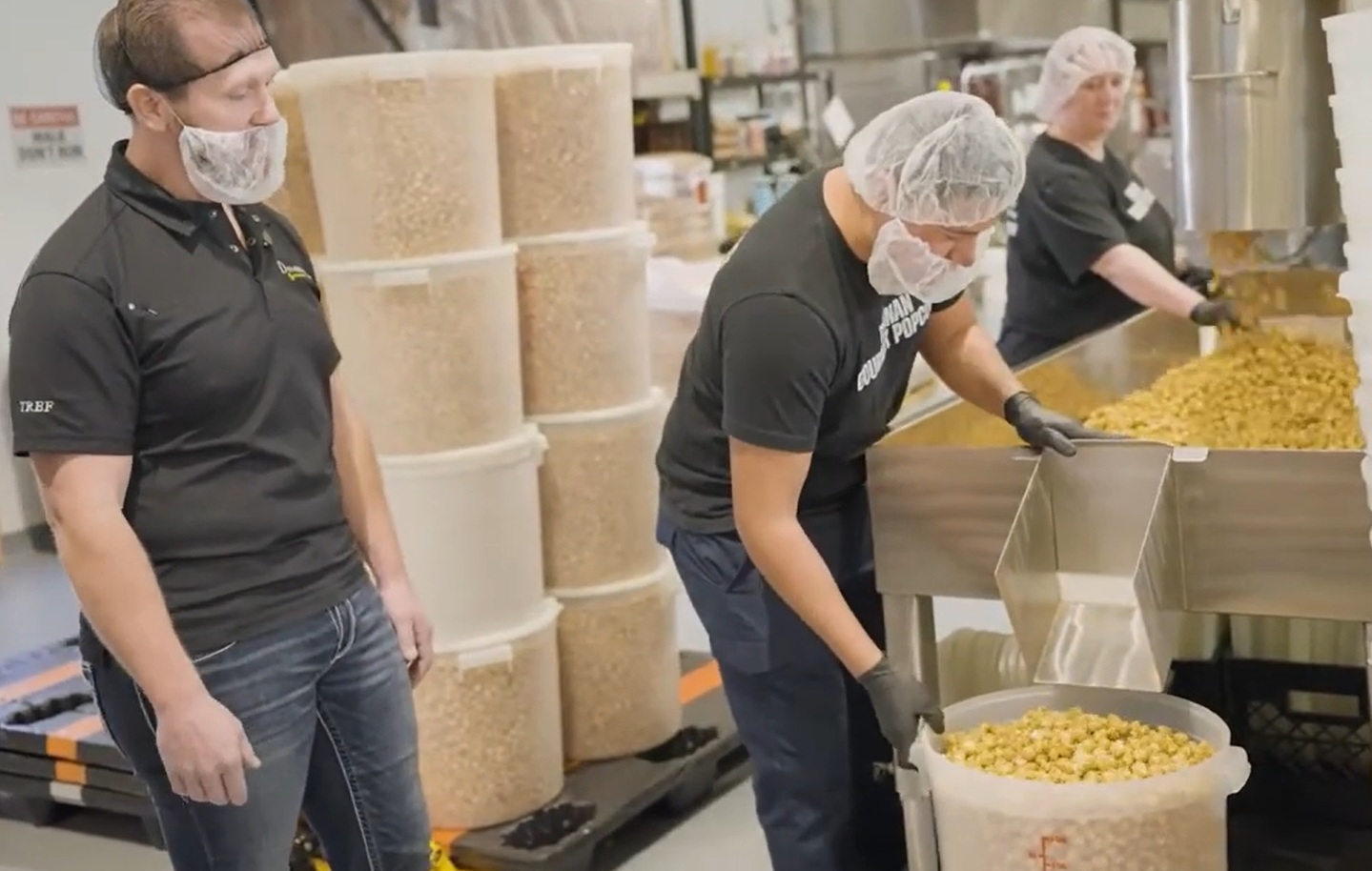
Controlling caramel behaviour during the batch
Caramel coating starts with preparing and heating the slurry to the required temperature and viscosity before it enters the coating kettle. Once the popcorn is added, the coating develops under controlled heat and agitation, where timing and mixing directly influence how the caramel distributes and sets.
Systems such as the M360 cooker/coater from AC Horn Manufacturing combine heating and mixing in a single step, allowing operators to define temperature and agitation profiles per recipe. This makes it possible to adapt the process to different caramel formulations while maintaining repeatable batch conditions.
Stabilising caramel during cooling and separation
Once discharged, caramel-coated popcorn needs to be cooled and separated before the coating fully sets. If this step is not controlled, clusters can form and reduce product uniformity.
Cooling conveyors and separator systems are used to reduce product temperature while mechanically breaking up clusters. By integrating these steps directly after coating, producers can stabilise the caramel structure and maintain separation between kernels.
Treating caramel coating, cooling and separation as one continuous process allows producers to achieve consistent product quality across batches, even as volumes and product variations increase.