Pan grinder mill
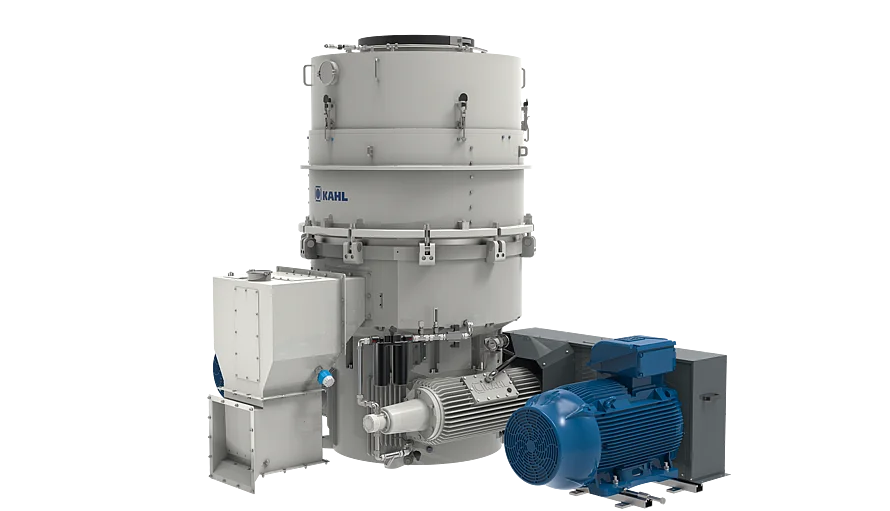
In biomass processing, size reduction defines how the rest of your line performs. When raw materials such as wood chips, shavings, or biogas substrates vary in moisture and fibre structure, conventional impact grinding leads to unstable throughput, uneven drying, and inconsistent product quality. The pan grinder mill introduces a controlled way to open and reduce fibres, preparing the material for the next processing step with a stable and predictable structure.
Stabilising pre-treatment for drying and pelleting
The pan grinder mill from Amanuds Kahl operates in the pre-treatment stage, where it conditions raw biomass before drying or densification. Instead of relying on high-speed impact, the system applies pressure and shear between rollers and a grinding surface. This controlled mechanical action breaks down fibres across their structure rather than shattering them, resulting in a homogeneous particle profile. The outcome is a material that behaves consistently in downstream processes, improving drying efficiency and enabling more stable pellet formation.
This approach is particularly effective for wet and fibrous materials, where traditional grinding technologies struggle with throughput and wear. The process reduces variability at an early stage, which translates into fewer fluctuations across the entire production line. By delivering a uniform feedstock, it supports higher overall plant efficiency and can reduce the need for secondary grinding steps.
From a line engineering perspective, the pan grinder mill functions as a process stabiliser rather than just a size reduction unit. Its operation lowers overall energy demand by reducing the load on downstream equipment and eliminates the need for aspiration systems typically associated with impact mills. The compact design and controlled mechanical process also contribute to lower noise levels and straightforward integration into both new and existing plants.
Within a complete biomass processing line, the pan grinder mill plays a key role in aligning raw material variability with the requirements of drying and pelleting. This makes it a relevant solution for wood pellet production, biomass-to-energy applications, and the preparation of organic substrates, especially where consistent output and energy efficiency are critical to plant performance.