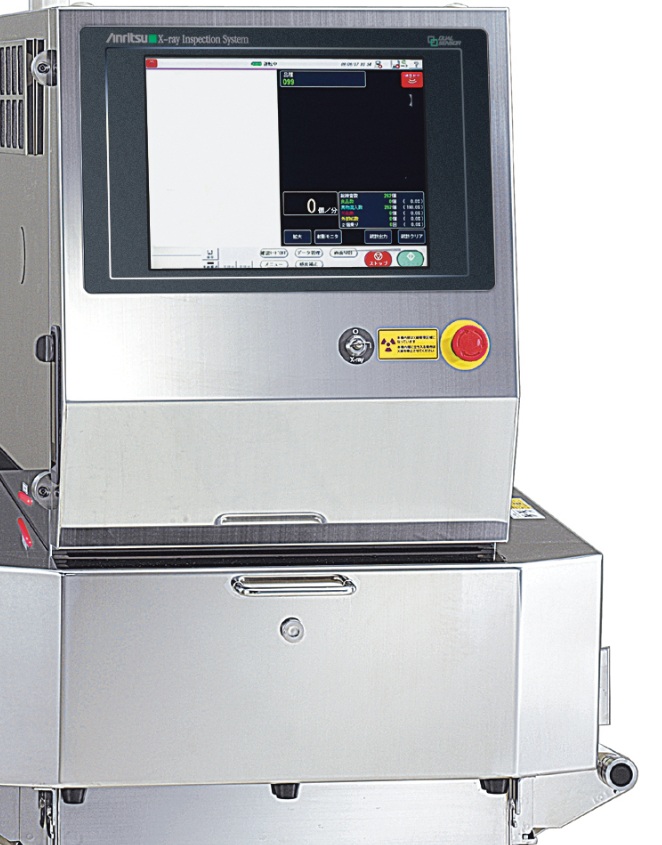
Poultry inspection decisions happen in milliseconds
The faster a poultry plant runs, the smaller the margin for inspection instability becomes. Small variations in product thickness, overlapping cuts, changing temperatures, moisture, vibration, and aggressive washdowns all influence inspection performance in real production conditions. What looks stable during a factory acceptance test can become far more challenging during continuous operation across multiple shifts.
That is exactly why poultry inspection requires a highly application-specific approach.

Poultry products create unusually difficult inspection conditions
Raw poultry presents several technical challenges simultaneously:
- variable product density,
- overlapping pieces,
- inconsistent thickness,
- high moisture content,
- and natural bone structures.
According to Anritsu, these factors can make contaminant detection considerably more difficult than in uniform packaged products. Inspection systems must distinguish between normal product variation and actual foreign materials without creating excessive false rejects.
The challenge becomes even greater in deboned and further-processed poultry applications where manufacturers expect detection of:
- metal,
- calcified bone,
- glass,
- dense plastics,
- rubber,
- and other foreign materials
while maintaining high throughput speeds.
Inspection has become part of yield protection
On many poultry lines today, inspection systems are no longer installed purely for food safety compliance. Increasingly, they are used to protect yield, minimize unnecessary giveaway, and reduce costly product rejection.
False rejects are especially expensive in poultry processing because they often interrupt upstream and downstream line flow. That makes stable inspection performance just as important as maximum sensitivity.
Anritsu highlights that modern poultry inspection therefore increasingly depends on:
- adaptive sensitivity control,
- stable imaging under changing product conditions,
- hygienic system construction,
- and reliable operation during continuous production shifts.
Harsh sanitation environments expose weak inspection designs quickly
Poultry processing environments are unforgiving:
- aggressive cleaning chemicals,
- high-pressure washdowns,
- humidity,
- fats,
- proteins,
- and continuous temperature changes
all place heavy demands on inspection systems.
For plant managers and technical directors, this changes the selection criteria entirely. The strongest inspection platform is rarely the one with the most aggressive laboratory sensitivity claim. The real benchmark is whether the system maintains stable inspection performance day after day under actual production conditions.
That is why poultry inspection increasingly becomes an operational reliability discussion rather than only a contaminant detection discussion. In practice, the most valuable system is often the one that keeps the line moving consistently while minimizing unnecessary interruptions.